


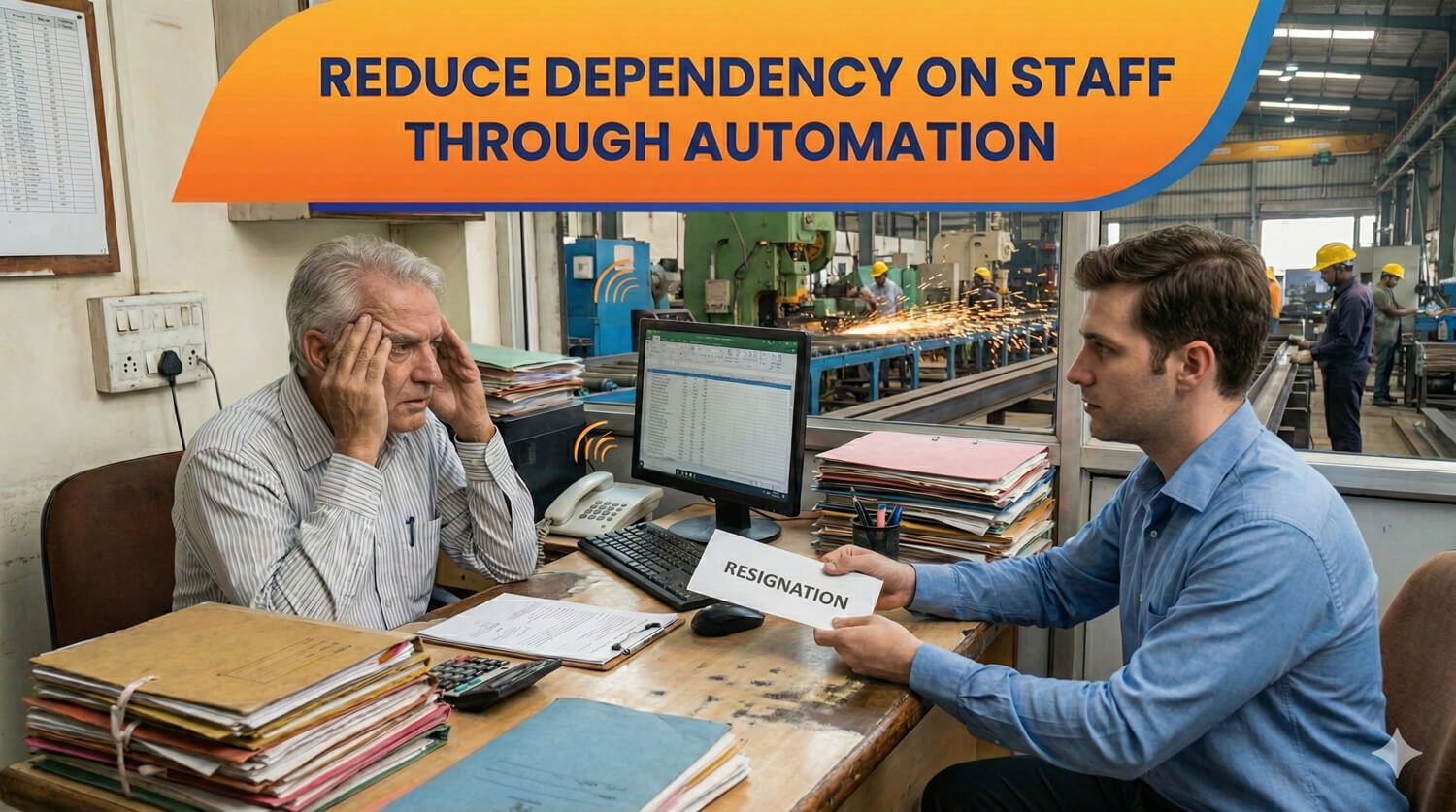
Your accountant resigns.
Your inventory manager goes on leave during peak season.
Your operations executive who “knows everything” leaves without documentation.
Suddenly, you realize your systems weren’t running the business. People were.
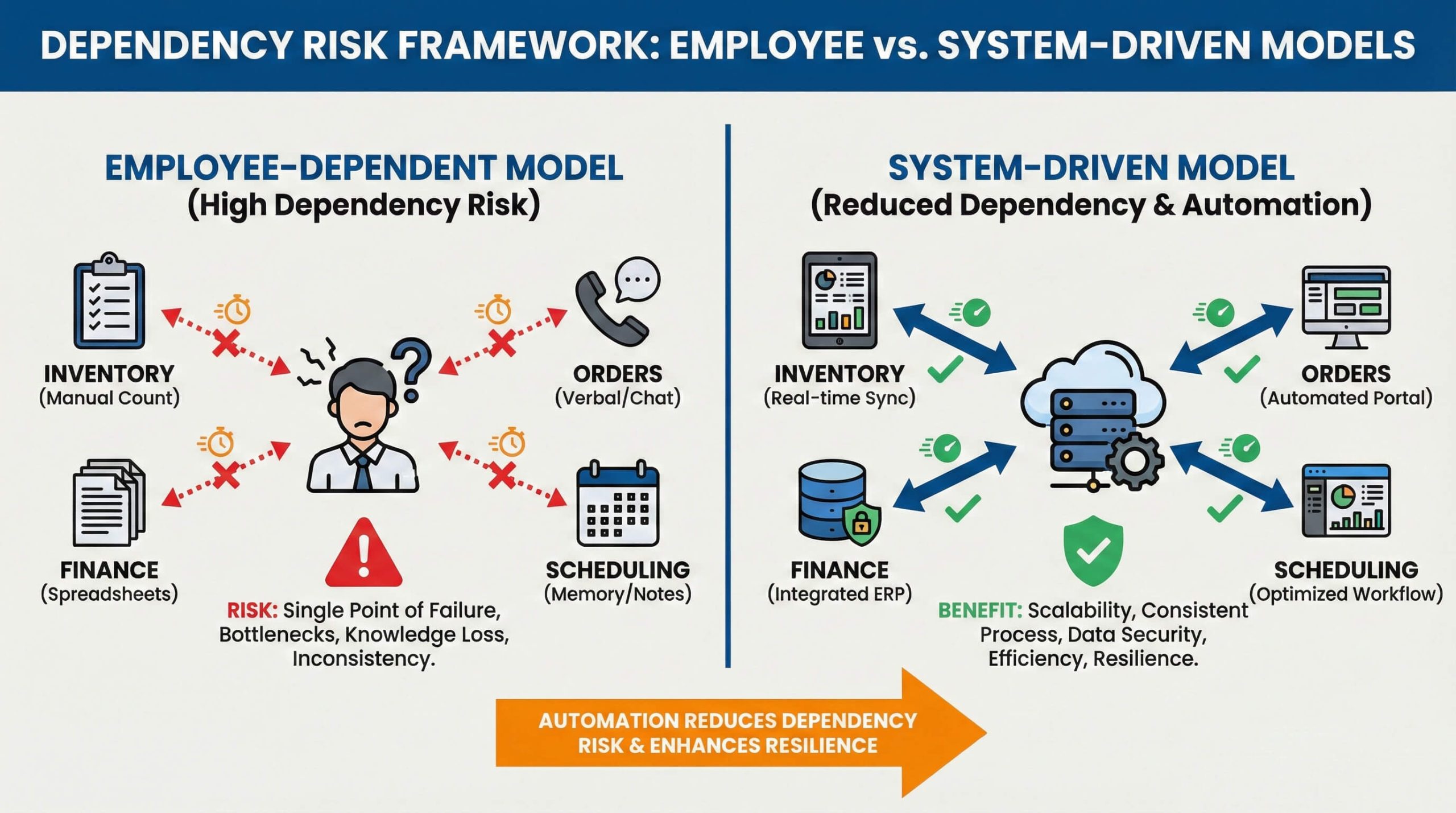
For many growing MSMEs, knowledge is stored in memory, not in process. This creates serious employee dependency risk. Automation doesn’t replace people it protects the business from single-point failure.
In this guide, you’ll see scenario-based examples of how automation helps reduce dependency on staff while improving continuity, accuracy, and control.
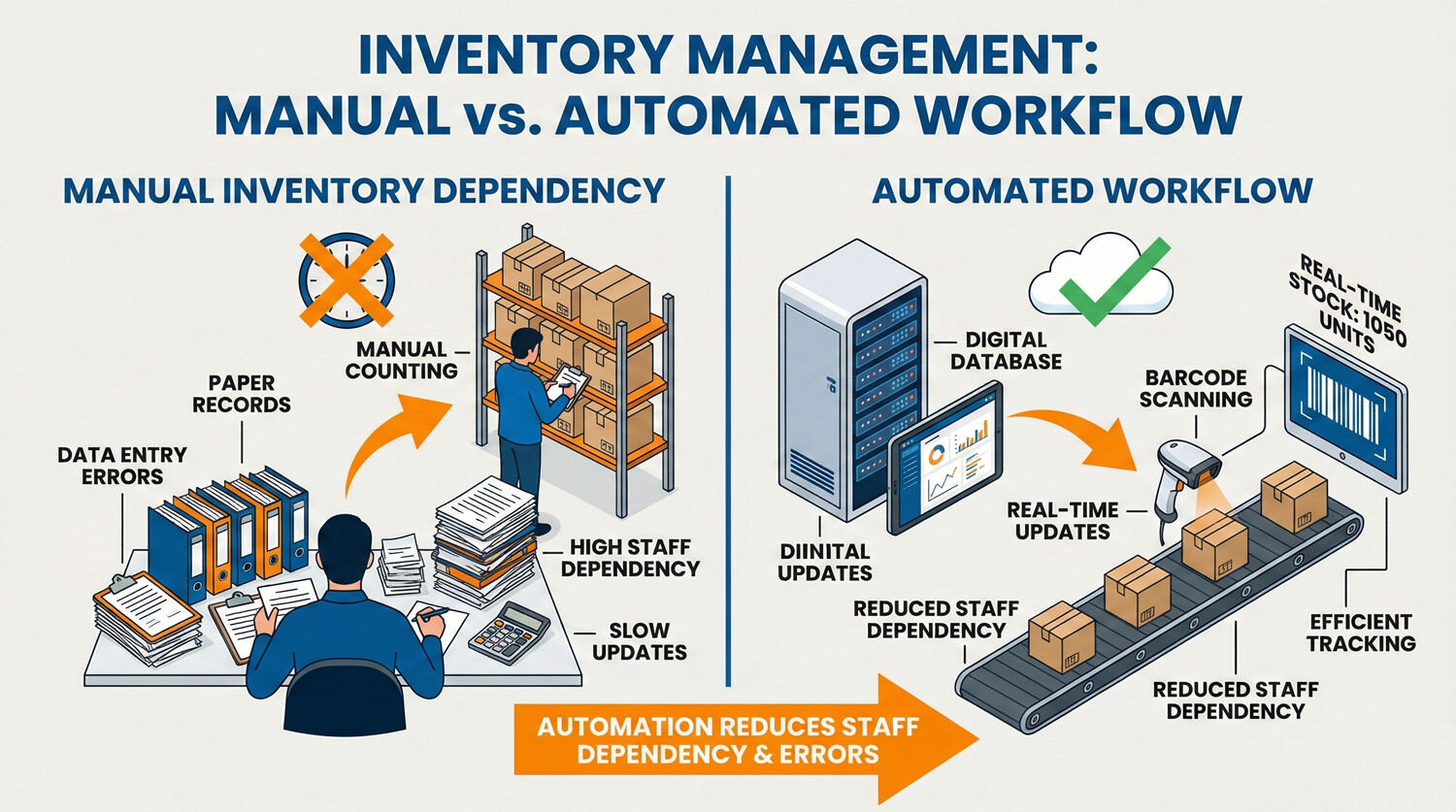
Scenario 1: The “Only Person Who Knows Inventory”
The Risk
One warehouse manager controls:
- Stock adjustments
- Purchase entries
- Dispatch coordination
- Physical reconciliation
If they leave, inventory becomes guesswork.
The Automation Shift
- Real-time stock deduction
- Barcode-based movement logging
- Automated purchase approvals
- System-generated variance alerts
When processes are automated, knowledge shifts from person to platform.
Scenario 2: The Accountant Who “Handles Everything”
The Risk
One person manages:
- Vendor payments
- GST reconciliation
- Cash flow tracking
- Ledger adjustments
If they exit suddenly, compliance exposure increases immediately.
The Automation Solution
- Automated invoice capture
- Integrated GST reporting
- Payment approval workflows
- Real-time financial dashboards
Automation benefits MSME finance teams by reducing interpretation dependency.
The system maintains structure even if personnel change.
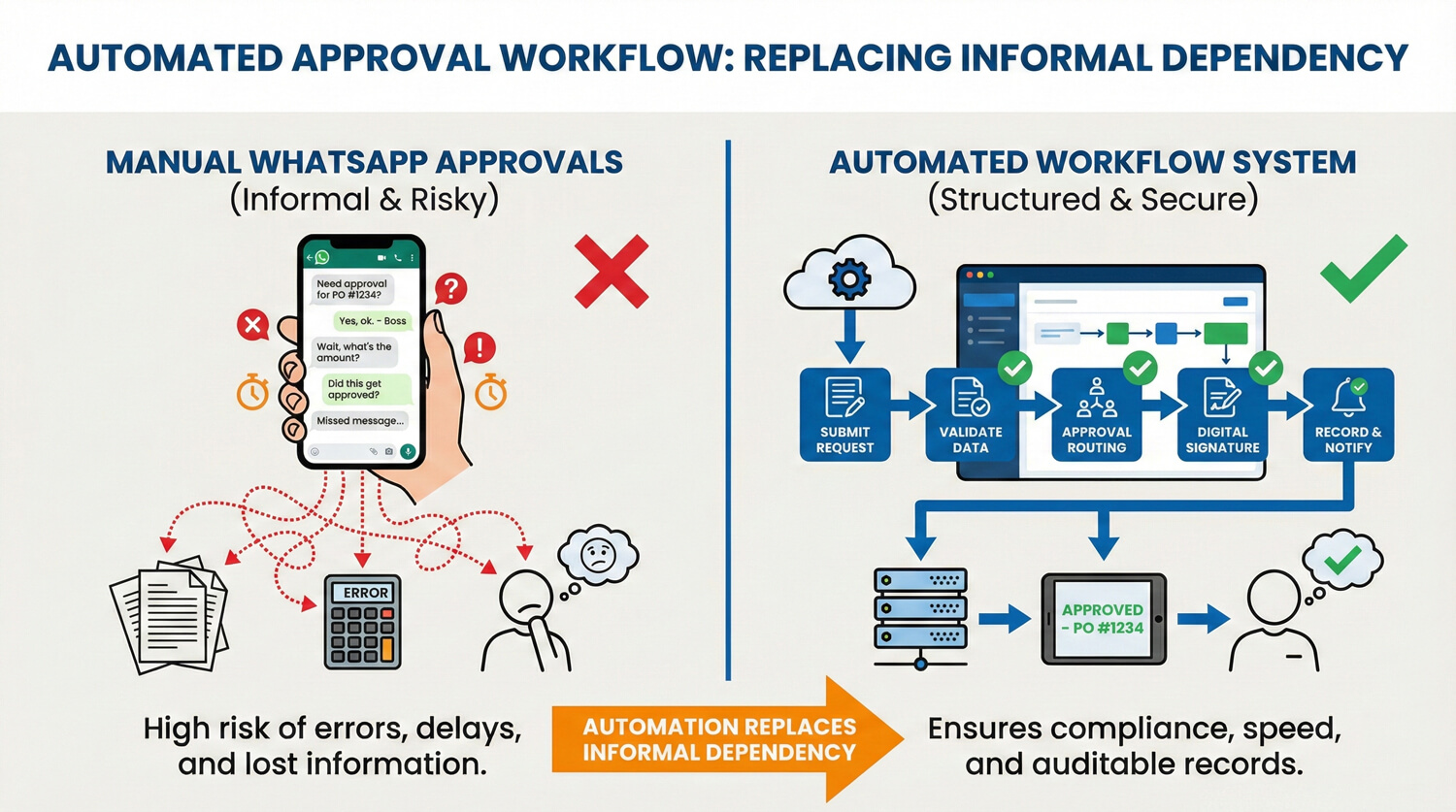
Scenario 3: Sales Operations Controlled via WhatsApp
The Risk
Approvals, pricing changes, credit limits all decided in chats.
When the sales coordinator leaves:
- Pricing logic disappears
- Discount history is unclear
- Customer credit control weakens
The Automation Fix
- Role-based approval workflows
- Centralized CRM tracking
- Automated credit limit enforcement
- Logged approval history
Now decisions are institutional not conversational.
The Real Cost of Employee Dependency Risk
Dependency doesn’t look expensive until disruption happens.
Common hidden risks:
- Operational delays
- Data inconsistency
- Compliance exposure
- Training overhead
- Founder stress
Automation is not about headcount reduction.
It’s about continuity insurance.
How Automation Reduces Dependency on Staff Systematically
Automation reduces risk in three structural ways:
1. Process Standardization
Every transaction follows a defined path.
2. Data Centralization
No private Excel files. No hidden formulas.
3. Role-Based Access
No one individual controls end-to-end without oversight.
These principles transform people from “knowledge holders” to “process operators.”
Quick Wins: Reduce Staff Dependency Immediately
Before full automation, start here:
-
Document recurring workflows
-
Separate approval from execution
-
Centralize all master data
-
Restrict single-user control over critical reports
If processes collapse when one person is absent, your risk exposure is already high.
When Automation Becomes Necessary
You likely need structured automation if:
- One employee controls critical reports
- You fear attrition more than competition
- Business stops when a specific person is unavailable
- Audit preparation depends on one individual
At this stage, automation is risk mitigation not technology upgrade.
Conclusion: Protect the Business, Not Just the Team
Three key takeaways:
-
Knowledge locked in people creates structural risk
-
Automation transfers knowledge into process
-
Risk reduction increases founder control
You don’t automate to reduce staff.
You automate to reduce vulnerability.
If attrition feels like a business threat, it’s time to evaluate structured AI & business automation not as growth tech, but as operational insurance.
How does automation reduce dependency on staff?
Automation standardizes processes, centralizes data, and enforces approval workflows. This ensures knowledge lives in systems rather than individuals, reducing operational risk during attrition.
What is employee dependency risk?
It’s the vulnerability created when critical operations rely heavily on one or a few employees. If they leave, operations slow or collapse.
Does automation replace employees?
No. It reduces dependency on specific individuals. Employees focus on decision-making rather than repetitive tracking tasks.
Is automation only for large companies?
No. Automation benefits MSME businesses significantly because smaller teams face higher risk concentration per individual.
Where should MSMEs automate first?
Start with inventory control, financial reconciliation, and approval workflows—areas where attrition creates immediate disruption.